How Corresponding Adjustments Prevent Double Taxation in Transfer Pricing Cases

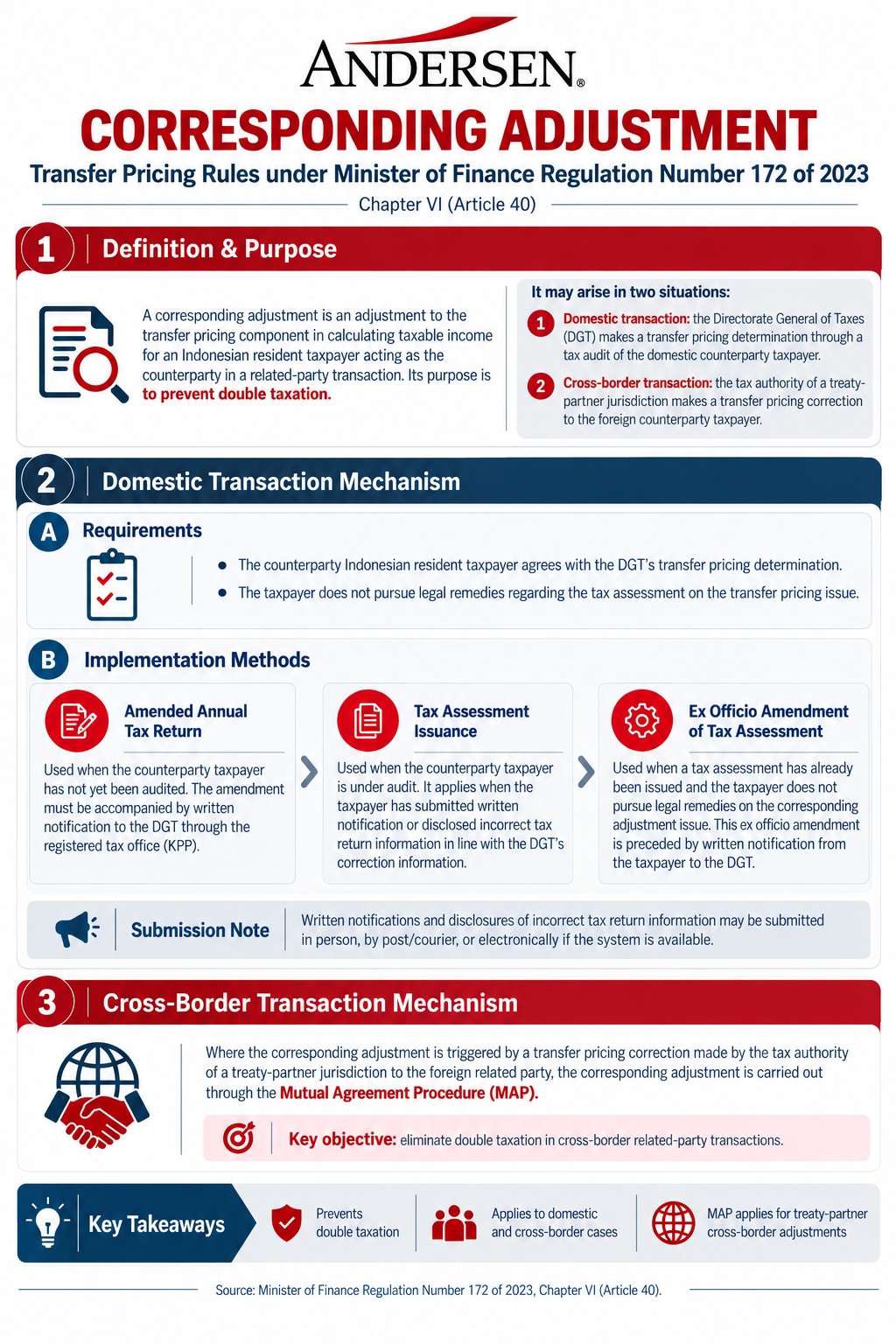
A corresponding adjustment allows an Indonesian resident taxpayer to adjust the transfer pricing component of their taxable income when a related-party transaction has already been corrected elsewhere, whether by the Directorate General of Taxes in a domestic case or by a treaty-partner tax authority in a cross-border case, in order to prevent double taxation. Under Article 40 Minister of Finance Regulation (“PMK”) No 172 of 2023, this adjustment can be carried out through an amended tax return, a tax assessment, or an ex officio amendment for domestic transactions, while cross-border cases are resolved through the Mutual Agreement Procedure (MAP). The infographic below outlines the requirements and mechanisms for both situations.


DGT Stops e-Objection Application, KSWP Info, and Ex-1 Portal: Services Switch to Coretax and KSWP Portal

The Directorate General of Taxes (DGT) officially stopped the operation of three of its service platforms, namely KSWP Info, e-Objection, and Ex-1 Portal. This closure step was taken following the implementation of the tax administration system update through the implementation of the DGT Coretax.

The decree was published through Announcement No. PENG-51/PJ.09/2026 On August 26,2026. The DGT said that all functions that previously ran in the three applications were now transferred to the new platform.

Before the Coretax system is active, applicable applications such as:

  • e-Objection plays a role in facilitating the submission of tax objections,
  • Checking the Taxpayer Status Confirmation (KSWP) Services is processed through KSWP Info, and
  • The Ex-1 portal is KSWP services specifically for government agencies and government agencies, including ministries, non-ministerial government agencies, provincial governments, regency/city governments, state-owned legal entities, state-owned enterprises, agencies, associations, and other parties (ILAP).

The KSWP has now replaced the DGT COretax

Once Coretax is running, the KSWP services that used to be in the KSWP Info is officially moved to Coretax DGT. Details of the changes include:

  • Previous application: KSWP Info.
  • Type of service: Taxpayer Status Confirmation.
  • Replacement application: Coretax DGT.
  • Site link: coretaxdjp.pajak.go.id.

That way, users can no longer use KSWP Info and must start using DGT Coretax.

e-Objection Switches to DGT Coretax

Taxpayers who want to take care of objections now no longer use e-Objection, but directly through the DGT Coretax. Adjustment points that must be noted include:

  • The e-Objection system was deactivated following the presence of the DGT’s Coretax.
  • All matters for submitting objections are transferred to the DGT’s Coretax.
  • The new link that can be accessed is coretaxdjp.pajak.go.id.

Ex-1 Portal Switches to KSWP Portal

Previously, the Ex-1 Portal in ex-1.pajak.go.id was used to serve KSWP for government agencies and institutions that are members of ILAP. Parties who need to pay attention to this migration include:

  • ministries and non-ministerial government institutions.
  • Local governments at the provincial and district/city levels.
  • State-owned legal entities and state-owned enterprises (SOEs).
  • Agencies, associations, and other entities within the scope of ILAP

Conclusion

Along with the implementation of the DGT Coretax, three legacy platforms were deactivated with the following diversion scheme:

  • KSWP info is transferred to DGT Coretax for the purpose of Taxpayer Status Confirmation.
  • E-Objection is transferred to DGT Coretax  for processing of objection applications
  • The Ex-1 Portal is redirected to the KSWP Portal to serve the KSWP for ILAP.

By Tommy Hendharto Oetomo – Managing Partner

Domestic Taxpayers and Indonesian Citizens: Different Reasons and Ways to Apply for MAP According to PMK 172/2023

Multinational corporations increasingly face the risk of double taxation on their cross-border transactions because the tax authorities in the two countries interpret the same transaction differently, especially transactions between affiliated companies that are subject to transfer pricing rules. These issues are difficult to resolve—lodging objections or appeals in one country seldom works, because domestic tax court decisions are not binding on the tax authorities of other countries. This is where the Mutual Agreement Procedure (“MAP”) becomes important. The mechanism, which is set out in all double taxation agreements (“DTAs”), allows the tax authorities from the two countries in question to negotiate directly to eliminate double taxation and restore legal certainty for affected taxpayers.

Even with a MAP in place, there is still room for variation in interpretation. To address this, and to further refine the country’s transfer pricing framework, the Indonesian Ministry of Finance issued Minister of Finance regulation PMK 172/2023 in December of 2023. The regulation provides further guidance on a number of transfer pricing topics, including on the MAP mechanism.

Per this regulation, an application to initiate a MAP can be submitted by four parties, two of which are most commonly used domestic taxpayers and Indonesian citizens but are regulated differently. It is important to understand these differences, since the status of the applicant has implications for which disputes can be submitted as well as the submission path, and a mistake in determining which option fits risks rejection of the application.

Under Article 1 of PMK 172/2023, a “domestic taxpayer” refers to an individual or entity that has tax rights and obligations in Indonesia, while an “Indonesian citizen” refers to an Indonesian citizen who has the status of a domestic taxpayer in the DTA partner country.

The grounds for submitting a MAP application also differ. Article 41, paragraphs (5) and (6) give domestic taxpayers broad scope for protesting: from transfer price corrections, double taxes due to partner country authorities, withholding income tax not in accordance with the DTA, to disputes over the status of tax subjects and discrimination, and even actions by the Indonesian Director General of Taxes (“DGT”). Indonesian citizens, on the other hand, are allowed only one reason per Article 41 paragraph (7), namely discriminatory treatment in a partner country that is contrary to the DTA non-discrimination clause.

There are also two distinct submission procedures:

  • Domestic Taxpayers apply for a MAP through the Tax Service Office where they are registered using the format in Attachment I.1 of PMK 172/2023.
  • Indonesian citizens submit a MAP application to the DGT through the Directorate of International Taxation instead of the Tax Service Office using the format in Special Appendix I.2.

The importance of understanding the differences when applying for a MAP is especially relevant for multinational groups with Indonesian employees who are stationed abroad and have domestic taxpayer status in DTA partner countries, as well as Indonesian entities that face cross-border transfer price corrections.

The Andersen in Indonesia team can help businesses with ensuring that applicants are using the correct category for their dispute, preparing supporting documents, and assisting with the MAP submission process in accordance with PMK 172/2023. Contact our team for a consultation before your MAP application deadline expires.

By Olina Rizki Arizal – Senior Partner

Tax Consultant Firm (KKP) in the Form of a Limited Liability Company (PT): What You Need to Know

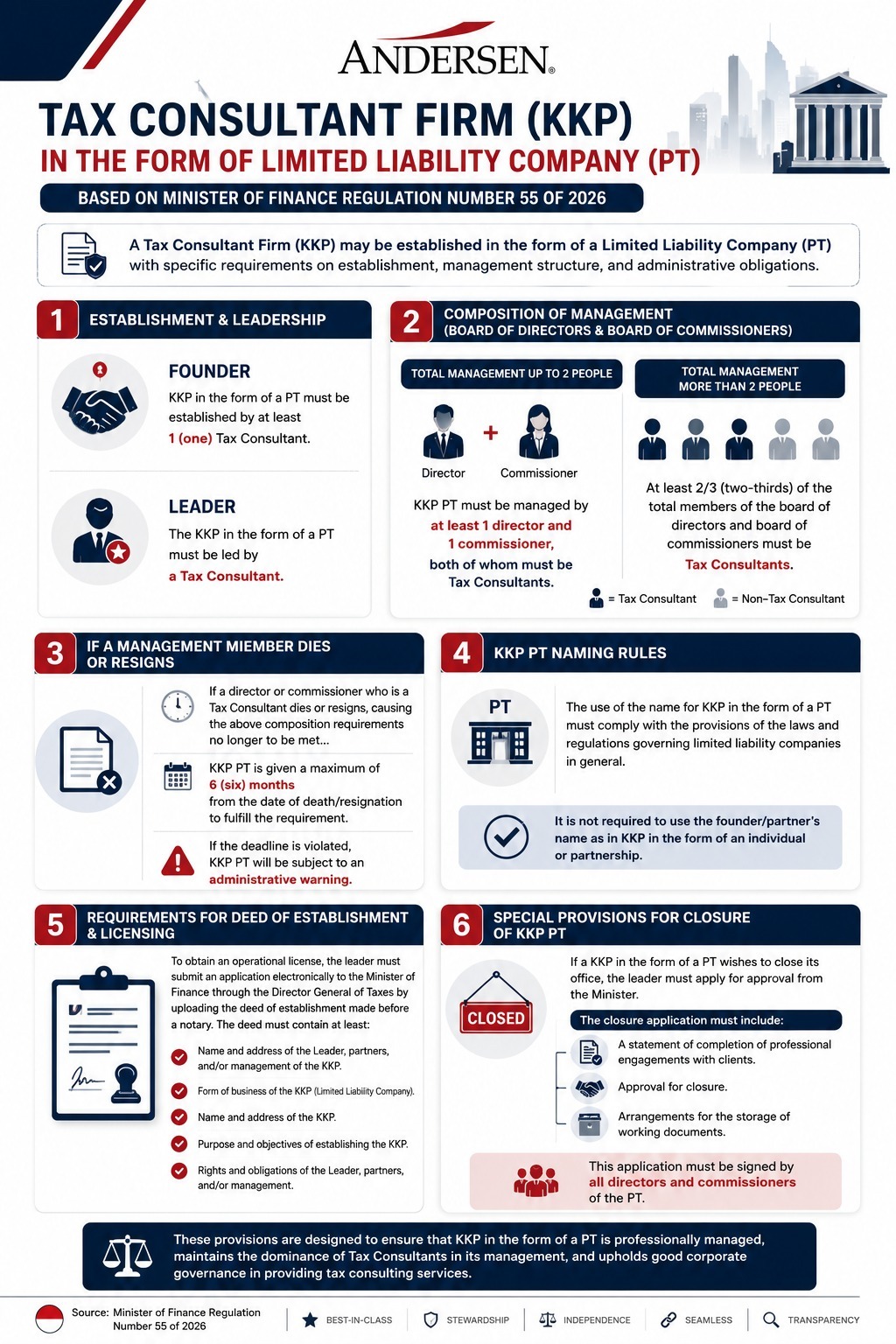
A Tax Consultant Firm (KKP) can now be established in the form of a Limited Liability Company (PT), based on Minister of Finance Regulation Number 55 of 2026. The regulation covers establishment and leadership requirements, the composition of the board of directors and commissioners, provisions for when a management member dies or resigns, naming rules for the KKP, and the process for closing the business. The infographic below summarizes the key points for Tax Consultants looking to establish or manage a KKP in the form of a PT.


Vietnam Cuts MSME Income Tax by 30%, What is the Position of Indonesia’s Tax Incentives?

Per the Warta Ekonomi article on August 24, 2026, the Vietnamese National Assembly passed, by a count of 480 to 1, a resolution to cut income tax by 30% in an extraordinary session. The cut applies to the 2026 and 2027 tax years for individuals, business households, and companies with a maximum annual income of VND10 billion (equivalent to approximately IDR6.76 billion). The move is part of a strategy to support the domestic economy while increasing the country’s attractiveness to investors.

At this threshold level, the policy is estimated to cover 99.86% of individuals and business households as well as more than 81.11% of companies in Vietnam. For taxpayers who have previously received other tax incentives under the Vietnam Corporate Income Tax Law, the 30% discount is calculated on the corporate income tax that is still payable after all applicable incentives are deducted.

MSME tax regulations in Indonesia

The income tax cuts in Vietnam bring up the question of how incentives for MSMEs in Indonesia compare. Indonesia already has regulations to provide tax relief for micro-, small-, and medium-sized enterprises (“MSMEs”). One of the main ones is a final income tax rate of 0.5% for taxpayers with a gross turnover of up to IDR4.8 billion in one tax year, originally issued under Government Regulation (“PP”) no. 55 of 2022 and recently amended by PP 20/2026. In contrast to Vietnam, under PP 20/2026, Indonesia does not set a limit to the periods this tax relief is available to individual taxpayers and corporate taxpayers in the form of sole proprietorship LLCs, although cooperatives are limited to a maximum of four years from the time of registration.

Under the recently issued PP 20/2026, corporate taxpayers other than sole proprietorship LLCs will no longer be allowed to use the MSME final income tax facility.

Transition Period for PP 20/2026

With the change in taxpayer eligibility, PP 20/2026 sets a transition period for corporate taxpayers other than sole proprietorship LLCs, such as limited partnerships, firms, LLCs, and village-owned enterprises and joint village-owned enterprises, allowing those whose final income tax period has not yet ended to continue to take advantage of the facility until the period is over.

Conclusion

Comparing Vietnam’s move with Indonesia’s regulations is relevant, even though the policy context is different. So far, Indonesia has chosen the route of restricting the subject and period of use of the MSME final income tax facility under PP 20/2026, instead of cutting taxes across the board as in Vietnam. Businesses need to pay attention to the deadline and category of taxpayers regulated by PP 20/2026, while monitoring whether there are any follow-up policies that lead to incentives similar to Vietnam’s.

For corporate groups with entities operating in Vietnam and other ASEAN jurisdictions, understanding the implications of cross-border fiscal policies is important for maintaining compliance while optimizing the group’s tax efficiency. The Andersen team in Indonesia is ready to help evaluate the impact of regional tax policies on your business operations, including with cross-jurisdictional tax planning and adjusting transfer pricing strategies. Contact the Andersen in Indonesia team for further consultation.

By Tommy Hendharto Oetomo – Managing Partner


Refrences:

[1] Economic News. 2026. “Taxes Cut by 30%, Vietnam Floods the Business World with Incentives.” August 24, 2026. Available at  wartaekonomi.co.id/read630495.

[2] Government of Indonesia. 2026. “Regulation Number 20 of 2026 concerning Amendments to Government Regulation Number 55 of 2022 concerning Adjustments to Regulations in the Field of Income Tax.”

Act Now: The 9-Month Deadline for GloBE Taxpayer Status Registration is Fast Approaching

This is a reminder to taxpayers about their obligations under Director General of Taxes (“DGT”) regulation no. PER-6/PJ/2026 dated May 4, 2026, the implementing regulation for the Global minimum tax (“GMT”) regime in Indonesia. Taxpayers subject to the regime, known as “GloBE” , must register their status online through the DGT Coretax Taxpayer Portal. The provision targets constituent entities or members of joint ventures in Indonesia that are members of a multinational group (“MNE group”) with a minimum consolidated gross turnover of EUR750 million.

The threshold is calculated from the consolidated financial statements of the main parent entity in at least two of the four years prior to the year of imposition of GloBE. Article 4 paragraph (2) of PER-6/PJ/2026 requires that applications to register for additional status as a GloBE taxpayer be submitted no later than nine months after the end of the year of the first GloBE imposition. Thus, groups that met the threshold in 2025 must register no later than September 30, 2026.

The information needed for the additional status as a GloBE taxpayer registration application includes:

  • Information on the Indonesian taxpayer
  • Information on the ultimate parent entity
  • MNE group information, such as the group name
  • First year of GloBE imposition
  • Address for correspondence
  • Person in charge of GloBE tax obligations for the group

This new global minimum tax regime obligation has a direct impact on MNE groups operating in Indonesia. Companies will need to first determine whether they are constituent entities subject to the requirement, then prepare accurate data on the parent company and the person in charge. If the registration application is not submitted by the deadline, Article 4 paragraph (7) PER-6/PJ/2026 authorizes the DGT to unilaterally add the GloBE status for the taxpayer.

How to add GloBE taxpayer status through the Coretax system

The DGT just released user guide version 1.1 dated September 3, 2026, on how to register as a GloBE taxpayer through the Coretax Taxpayer Portal. The guide, which is only available in Bahasa Indonesia, is attached to his article. We provide a brief summary of the process below.

The taxpayer’s person in charge should handle this process.

  • Log into your personal Coretax account.
  • Choose the “impersonate” feature to access the corporate taxpayer’s account.
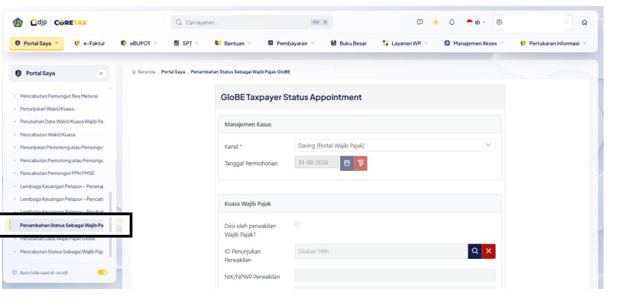
  • Select the “My Portal” menu, the “Status Change” submenu, and the “Adding Status as a GloBE Taxpayer” submenu.
  • Fill in the requested information (see the screenshot below).

Most of the data on the form, such as the application channel, application date, and taxpayer identity, is automatically filled in by the system. The part that must be filled in manually is the identity of the ultimateparent entity. If the taxpayer who registers is an ultimate parent entity and is domiciled in Indonesia, the NPWP data, name, address, country, and accounting period are automatically filled in. Otherwise, the information must be completed manually, including the Tax Identification Number if the ultimate parent entity is domiciled abroad.

Next step Taxpayer enters the PMN Group name, the first GloBE imposition year, and a correspondence address (which may follow the registered Taxpayer address), along with the PIC’s administrative contact details (NIK/NPWP, name, email, phone).

Conclusion

PER-6/PJ/2026 emphasizes that reporting on GloBE Taxpayer status is not just an administrative formality, but a condition with a strict deadline that determines the MNE group’s compliance with the global minimum tax regime in Indonesia.

Andersen in Indonesia is ready to help MNE groups map out their GloBE taxpayer status obligations, prepare registration documents, and monitor the progress of the implementation of PER-6/PJ/2026. Contact our team for assistance.

By Olina Rizki Arizal – Senior Partner

The Rules for Taxpayer Proxies have Changed: Here’s What Taxpayers Need to Understand Before 2027

The rules on taxpayer proxies have changed. The government has officially enacted Minister of Finance Regulation (PMK) No. 44/2026 on July 6, 2026, revoking the old regulation, PMK 229/PMK.03/2014. Notable changes include new competency requirements and strict transition deadlines. Taxpayers, especially multinational companies or entities with complex tax structures, who are used to assigning tax consultants, employees, or other parties as their tax proxy should be prepared to meet the new requirements.

What’s changed?

Previously, only two parties could be appointed as tax proxies—tax consultants and taxpayer employees. Now there are three categories, namely:

  • Tax consultants
  • Other parties
  • Family members

A big change is the introduction of family members as its own category, for which there are no competency requirements for husbands, wives, or relatives by blood or marriage up to the second degree. Evidence of the family relationship must be provided, such as a copy of the Family Card or a family relationship statement (Article 7, paragraphs 3-4). This is good news for individual taxpayers and small and medium businesses who may have difficulty in accessing licensed tax consultants.

The terms of appointment have also been adjusted. As stated above, if the taxpayer appoints a family member, they do not need to attach the certificate of registration (or “SKT”). Tax consultants are automatically considered competent as special attorneys. However, those in the “other party” category are required to have an SKT to prove their competence. (Further details on other parties and the procedure to obtain the SKT will be provided through a separate ministerial regulation that has yet to be issued.)

There are restrictions on who can become a tax proxy. Article 4 prohibits tax consultants or other parties who are subject to sanctions of freezing or revocation of permits or SKT. Former employees of the Ministry of Finance are also subject to stricter rules: those who have retired or quit before retirement age, and former employees with employment agreements (PPPK) are required to wait at least five years after they have stopped working, and they must never have been subject to severe disciplinary measures while serving.

New format for the special power of attorney. Given the expansion of parties eligible to be appointed as an authorized representative, the old format for a special power of attorney needed to change since it only accommodated tax consultants. The new format allows for the three categories of representatives, each with different supporting document requirements. The new format also explicitly adds a validity period for the power of attorney, an itemized breakdown of the authority granted, and a statement granting access to the taxpayer’s electronic account in the DGT’s system, in line with the rollout of the Coretax electronic tax administration system.

Transition period

PMK 44/2026 provides for a transitional phase. Special powers of attorney that were made before this rule entered into effect are still valid. Holders of brevet certificates or tax diplomas with at least a Diploma III accredited A can still be a power of attorney until December 31, 2026, as long as the power of attorney is made in paper form with a photocopy of the certificate or diploma attached.

For companies that have been using employees with brevets or diplomas as proxies, this is the time to prepare. Their status needs to be adjusted to “other parties” with an SKT before the transition deadline expires, even though the technical rules regarding the SKT itself have not yet been issued. The format of the special power of attorney must also be updated because it must now explicitly state the status of the power of attorney.

Actions to take now

For taxpayers, especially multinational companies that tend to have internal proxies, these three things should be a priority to avoid tax proxies losing their authorization precisely when it is needed most:

  • Map all parties that can be appointed as active proxies and their competency bases.
  • Update special power of attorney documents according to the new format.
  • Monitor the issuance of technical ministerial regulations on SKT.

Windfall Tax: Is it Ready for Implementation in Indonesia?

The global oil and gas market has seen a significant price surge as of March 2026. This spike is driven by supply chain disruptions, fluctuating productivity, and international geopolitical tensions that have triggered commodity price instability.

This volatility poses a serious risk of inflation, as oil and gas become increasingly difficult to source and domestic supplies grow scarce. This scarcity, in turn, is expected to drive up the cost of basic domestic necessities.

Conversely, this situation presents a massive windfall for oil and gas companies, as prices skyrocket due to limited supply. For governments, these extraordinary market conditions offer a potential boost to national revenue through a supplemental levy known as a Windfall Tax.

Understanding Windfall Tax

A windfall tax is an additional levy imposed on profits resulting from sudden surges or extraordinary situations within the commodity market.

  • It aims to increase state revenue from the tax sector.
  • It is calculated by establishing a threshold for what is considered “excessive” or “unusual” profit.
  • If a company’s profits exceed this established limit, the windfall tax is applied.
  • The primary disadvantage is that it can act as a deterrent for investors looking to fund commodities subject to the tax.

Implementation in Asia

Several countries in Europe and Asia have already adopted this tax. Notable examples in Asia include:

  1. Malaysia
    Applied a 3% windfall tax on Crude Palm Oil (CPO) companies in 2022 when prices exceeded RM3,000/ton in the Peninsula and RM3,500/ton in Sabah and Sarawak. Additionally, a 33% tax was levied on companies with profits exceeding RM100 million in 2022.
  2. India
    Implemented a windfall tax in 2022 on petroleum products, including Aviation Turbo Fuel (ATF). The rate for ATF was set at INR6 per liter, reviewed fortnightly based on crude oil prices. The tax was officially abolished in 2024 following a decline in global oil prices.

The Outlook for Indonesia

While a windfall tax serves as a viable alternative to boost national revenue during unexpected price hikes, the Indonesian government is still in the evaluation phase. As of now, Indonesia has not yet implemented a windfall tax on unexpected commodity profits.

A windfall tax is an alternative additional tax imposed on certain commodities experiencing unexpected price increases. This windfall tax can increase state revenue through the additional tax levied when commodities experience unexpected price increases. However, on the other hand, a windfall tax can also discourage investor interest in the commodities affected by the windfall tax.

By Olina Rizki Arizal – Senior Partner