VAT and Luxury Goods Tax: The Pillars of Indonesia’s Tax Revenue

Despite the current international economic instability, Indonesia’s Value Added Tax (VAT) and VAT on Luxury Goods recorded significant growth in February 2026. According to the APBN KiTA press conference in March 2026, these sectors contributed a staggering 97.4% of the total increase in state tax revenue compared to the same period last year. This growth is particularly notable given the geopolitical tensions impacting the global economy, such as the ongoing conflict between Russia and Ukraine and the escalating friction in the Middle East involving the United States, Israel, and Iran. These conflicts have direct consequences on international trade, most notably the closure of the Strait of Hormuz. The Strait of Hormuz is a critical global artery for oil trade. Its closure has led to:

  1. Numerous vessels from various nations are currently immobilized in these waters.
  2. The resulting shortage of suppliers threatens domestic oil stability and can severely disrupt national economies.
  3. Crude oil prices are climbing due to the restricted access to this vital trade route.

The Minister of Finance has assessed that the Indonesian economy remains on an upward trajectory. The surge in consumption-based tax revenue (VAT and Luxury Goods Tax) serves as clear evidence that domestic economic activity and transactions remain stable despite international pressure. To maintain this momentum and safeguard against an economic crisis, the government has committed to several strategic measures:

  1. Keeping the state budget deficit below the 3% limit of Gross Domestic Product (GDP).
  2. Developing adaptive fiscal policies to mitigate the impact of rising global oil prices.
  3. Ensuring the national economy remains strong, stable, and resilient against global shock

The government as the state administrator, is expected to maintain stability in the Indonesian economy and prevent it from experiencing an economic crisis amidst the current global turmoil. Therefore, the government needs to formulate fiscal policies to address this situation, especially given the rising crude oil prices resulting from the closure of the Strait of Hormuz, which serves as a key access point for global crude oil trade.

By Tommy HO – Managing Partner

In Order to Increase State Revenue, Here Are the Steps the Government Is Taking

At the limited coordination meeting held on Monday, March 16, 2026, at the office of the Coordinating Ministry for Economic Affairs, the Ministry of Finance stated that it would strive to increase revenue without raising taxes and would implement tax efficiency.

For your information, according to the February 2026 edition of the State Budget (APBN KiTA), tax revenue grew 30% in the first two months of 2026 compared to 2025. This indicates that the government’s efficiency efforts are considered quite successful, with a 30% increase in tax revenue. To ensure continued revenue growth, the government are taking the following steps:

  1. Tax Efficiency: Tax efficiency can be achieved by making adjustments to tax revenues and improving the community’s economy, which will have a direct impact on tax increases. The community’s economy is improving, as evidenced by the growth of VAT and Sales Tax on Luxury Goods. In the first two months of the year, VAT and Sales Tax on Luxury Goods growth reached 95% compared to the previous year. This indicates that the community’s economy is better this year than last.
  2. To plug tax revenue leaks, the Ministry of Finance will attempt to address these by identifying companies suspected of under-invoicing to increase state revenue. Under-invoicing is an illegal practice involving lowering the value of goods on import or export invoices to lower their actual value. This is intended to manipulate taxes and reduce import duties, potentially causing state losses. The Ministry of Finance has identified 10 companies engaging in under-invoicing.
  3. Not raising subsidized fuel prices. Amidst global turmoil and Iran’s blockade of the Strait of Hormuz, oil shortages could lead to soaring prices. However, the Ministry of Finance has not yet raised subsidized fuel prices and will review and optimize budgets for several programs within ministries and agencies to cover the price increase unless the price increases are too high.

The increase in state revenue growth is a positive sentiment amid the current international turmoil. This growth indicates that the domestic economy is still improving. The government is expected to continue maintaining revenue growth to prevent social anxiety disorder, or excessive fear in the community, due to the recent global turmoil. It is hoped that the government can also take steps that are considered strategic to boost state revenue.

By Olina Rizki Arizal – Partner

How to Read Financial Statements?

In every business, it is important for us to read financial statements, whether you are an owner, an investor, a commissioner, a director, a manager, a creditor, a tax officer, an auditor and an accountant.

Financial Statements consist of cash flows statements, statement of financial position, statement of comprehensive income, statement of shareholder’s equity, and notes to the financial statements.

First, let’s talk about cash flows statement, this a heartbeat of every business, these established business makes profit regularly (sometimes it is not) and equally important to keep good financial condition in terms of a good rating, banks are willing to lend money to the company on very competitive terms. In other hand, if our business needed more capital for expansion, new investors would be willing to supply fresh money to our business. None of this comes simple or easy!

It takes good management to make profit, to raise capital and to
stay out of financial difficulties.

Basically, there two method or types of cash flows statements format, whether its direct or indirect method. The main difference is only in presentation of its operating activities. Direct method will be showed source of cash receipt from who or payment to whom while indirect method will adjust net income with non-cash transaction, such as depreciation, amortization, provision and showed working capital details within current assets and current liabilities.

The cash flows statements, in its bottom line the net of three activities, operating activities, investing activities, and financing activities, all of them simply reflected from increase or decrease of current month compared with prior month. If negatives cash flows on one of these activities, it means cash used by our business during the current month. Otherwise means cash provided by our business.

When an asset account is decreasing compared with prior month, it means cash receipt and shows with Rp123 as a source of cash inflow. Otherwise, whenever a liability account is decreasing compared with prior month, it shows cash paid and shows with (Rp345) as a source of cash outflow.

Operating activities reflect every changed in current assets and current liabilities whether its increase or decrease, such as cash receipt from customer, cash payment to vendor for main material or internet service provider in order to produce goods or services, cash payment to electricity provider or maintenance, cash payment to tax office, cash payment to employees in production, marketing, general and administrative department.

Investing activities reflect every changed in non-current assets whether its increase or decrease, such as capital expenditure, purchase or disposal of fixed assets and borrowing costs for capital costs.

Financing activities reflect every changed in non-current liabilities and equities whether its increase or decrease, such as loan received, principal loan payment, interest loan payment, dividend payment, additional paid-in capital and debt to equity conversion.

Overall activities produced a net of cash surplus or deficit during the current month compared with prior month.

Well, here is the two most important types of information that cash flows statements does not tell us:

  1. Profit earned or loss suffered by our business for this current month.
  2. The financial condition of the business at the end of this current month.

Second, the statement of financial position will show performance of our business, in fundamental analysis we could be used financial ratios for its performance measurement in order to review our going concern by analyze for short-term and long-term abilities of our business to survive in maintain its cash flows and liquidity to pay our obligation and loans. We should be remembered about DuPont analysis in terms of break-down of Return on Equity or “ROE” into three parts:

  1. Profitability measured by Profit Margin.
  2. Operating efficiency measured by Asset Turnover.
  3. Financial leverage measured by Equity Multiplier.

Formula of ROE = (Profit Margin) x (Asset Turnover) x (Equity multiplier) = (Net profit/Sales) X (Sales/Assets) x (Assets/Equity) = (Net Profit/Equity).

If ROE showed 20%, it means every Rp100 of our equity provides Rp20.

Most of us should be noted that all of these accounts are not cash basis but accrual basis, e.q. it means that our sales revenues in statement of comprehensive income, its details derived from cash sales and credit sales, if credit sales. Outstanding of account receivables will be remained until its settled by our customer to pay within agreed term of payment.

Third, the statement of comprehensive income, there are two format, first format showed sales revenues, cost of goods or service sold, gross profit, sales marketing, general and administrative expenses, depreciation expenses, operating income, interest expenses, tax expenses and net income. This net income will be moved into retained earnings account in equity of statement of financial position. Second format showed Other Comprehensive Income or “OCI”, basically there are five components of OCI:

  1. Revaluation surplus of fixed assets. Refer to Indonesian Financial Accounting Standars “Pernyataan Standar Akuntansi Keuangan” or “PSAK” 16.
  2. Gains or losses on actuarial valuation for defined benfits. Refer to PSAK 24.
  3. Gains or losses on translation of financial statements for foreign entity. Refer to PSAK 10.
  4. Gains or losses on financial assets remeasurement and classified as available for sale. Refer to PSAK 55.
  5. Gains or losses on cash flow hedging. Refer to PSAK 55.

Earnings Before Interest, Tax, Depreciation and Amortization or “EBITDA” is one of tool to determine achievement of current month performance compared with monthly budget.

Sometime, in manufacture contribution margin format of statement of income will helpful to calculate Break Even Analysis. Sales revenues deducted with variables costs then results its contribution margin whether its positive or not. Simply used contribution margin in Rupiah divided by goods or services sold in unit equivalent to obtain contribution margin per unit, i.e., Rp100 per unit. If we would have fixed investment Rp1.000 then dividend with Rp100 per unit contribution margin, we should be able to sell 10 units to reach our Break Even.

Fourth, the statement of shareholder’s equity will show the beginning balance of retained earnings added with current month net income then deducted with cash dividend, if any. Finally bottom line will be reflected in retained earnings account in equity of statement of financial position (refer to third point as per above mentioned).

Fifth, the notes to financial statements represent full disclosures of current condition of our business process in accordance with Generally Accepted Accounting Principles (as mentioned above, Indonesian Financial Accounting Standards in Indonesia, it’s called PSAK which in progress to full adoption into current issued of International Financial Reporting Standards or “IFRS”) then connected to relevant amount which have disclosed in references within cash flows statements, the statement of financial position, the statement of comprehensive income and the statement of shareholder’s equity.

Hopefully, we will be able to read financial statements in better ways in whatever our roles and responsibilities!

By Gerry Tjandra – Partner Tax and Accounting

Nadiem Makarim at Court Defending the Founder’s Share Tax with Prosecutor

Based on the link (https://www.youtube.com/shorts/vPVu7iGn6Sk) we can see that the prosecutor deemed that Nadiem has an income of IDR 5,2 trillion from amount that reported on Nadiem personal income tax return (PITR). Nadiem defended that the tax reported on his PITR is not based on income but based on the Gojek share’s that conducted an initial public offering (IPO).

An IPO is a strategic move by a company to raise additional capital from investors by listing the company on the Indonesia Stock Exchange (IDX). The Directorate General of Taxes (DJP), as the Indonesian tax authority, has issued Ministry of Finance regulation number 282/KMK.04/1997 as lastly changes with the Minister of Finance regulation number 81 of 2024, which stipulates that founding shareholders are subject to an additional final tax of 0.5% of the share value at the time of the IPO. This final tax is levied when the shares begin trading on the stock exchange and is not affected by any subsequent sale of the founding shareholders’ shares. If the founding shareholders also sell these shares, there will be two instances of final tax being levied: a final income tax on share transactions on the Indonesia Stock Exchange amounting to 0.1% of the transaction value, and an additional 0.5% on the founding shareholders’ shares. Founding shares are shares held by the company’s founders at the time of the IPO. Founding shares include:

a. Shares resulting from the capitalization of share premium issued after the IPO.

b. Shares resulting from a stock split of the founder’s shares.

Article 247 of The Minister of Finance regulation No. 81 of 2024 defines a founder as an individual or entity whose name is recorded in the list of shareholders of a limited liability company prior to the registration statement submitted to the financial services authority in connection with the initial public offering becoming effective.

An additional tax of 0.5% is applied to founding shareholders and becomes payable when the company’s shares are traded on the stock exchange; it is collected by the issuer no later than one month after the additional income tax becomes payable, and the issuer issues and delivers proof of collection to the founding shareholders.

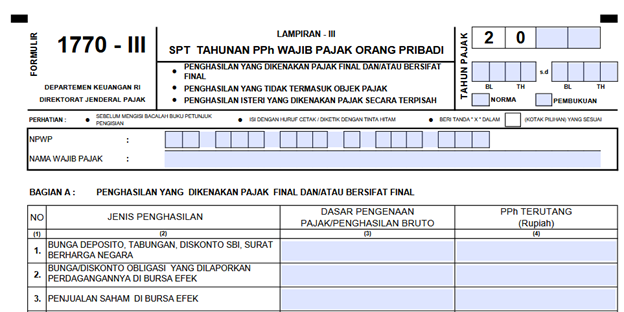
This additional taxation on founder shares at the time of the IPO means that the company’s founding shareholders should by recognize the income tax subject to final income tax on share transactions and enter it in form 1770 attachment III in section A.3.

Even though, in practice, it does not increase the wealth of the founding shareholders but is an expense. Under these provisions, an IPO entails an additional tax liability of 0.5% for founder shareholders, regardless of any share sale transactions.

By Tommy HO – Managing Partner

Reference:

1. The Minister of Finance Regulation No. 81 of 2024 on Tax Provisions in Connection with the Implementation of the Core Tax Administration System.

March Growth at 30.4%, State Budget Revenue from Tax Sector Continues to Strengthen

The Ministry of Finance has released the APBN KiTa press conference March 2026 edition, which publishes national tax revenue data. Tax revenue at the end of February 2026 showed a positive increase amid growing global turmoil due to the war in the Middle East between the United States and Israel on one side and Iran on the other.

Based on the press conference and data from the March 2026 edition of the KiTa State Budget, net tax revenue realisation as of 28 February 2026 reached Rp245.1 trillion. This shows that there was a 30.4% year-on-year (YoY) growth compared to the same period in the previous year. When compared in gross terms, there was a 12.7% growth. The main drivers of the surge in tax revenue were VAT and Sales Tax on Luxury Goods amounting to Rp85.9 trillion, with growth reaching 97.4%. This was due to increased domestic economic activity ahead of Eid al-Fitr, indicating that economic transactions were on the rise. In addition, there are four industries that dominate the contribution, reaching 74% of total gross tax revenue. The first industry is the manufacturing industry, which grew by 29.7%, supported by the tobacco and other chemical products sub-sector due to business line sales. In second place, the trade sector also grew by 24.7%, influenced by the wholesale trade sub-sector, particularly online trading. In third place, the mining sector grew by 10.0%, influenced by oil and gas mining due to changes in domestic VAT deposit administration. In last place, the finance and insurance sector grew by 9.6%, supported by financial service support activities. In addition, income tax also provided good growth in line with the increase in taxpayer income.

It is hoped that this increase will continue amid global uncertainty in order to maintain state budget revenue from the tax sector. The government has a crucial role to play in ensuring taxpayer compliance so that tax revenue can be maintained until the end of the year.

By Olina Rizki Arizal

Reference:

  1. The APBN KiTa press conference March 2026 edition

How to Calculate Global Base Erosion (GloBE) Reconciliation?

Global Base Erosion (GloBE) emerged due to the phenomenon of base erosion and profit shifting. Base erosion and profit shifting is the act of tax avoidance by transferring profits to countries with low or zero tax rates, carried out by multinational companies. Several steps are required to calculate GloBE. The calculation steps are as follows:

  1. Pre-calculation step: At this step, required to determine the Ultimate Parent Entity (UPE) or the company at the top of the multinational company’s ownership hierarchy. Must also ensure that the UPE has passed the consolidated income of Euro 750 million for 2 years out of a minimum of 4 tax years prior to the imposition of GMT. In addition, the Constituent Entity (CE) in each jurisdiction that is subject to GloBE tax must also be determined.
  2. First step: At this step, required to determine whether to use International Financial Reporting Standards (IFRS) or Generally Accepted Accounting Principles (GAAP) for the financial statements. Ensure that the currency of each CE jurisdiction is used.
  3. Second step: At this step, required to calculate the financial accounting net income (FANI) by using the profit/loss calculation before tax for each CE and removing the accounts that contain extraordinary and non-recurring journal amounts.
  4. Three step: At this step, multinational companies are required to adjust FANI to GloBE income by making several corrections to income, expenses, and timing.
  5. Fourth step: At this step, multinational companies combine GloBE income per country by adding up the GloBE income for each country.
  6. Fifth step: In this step, the covered tax is determined, which consists of current tax and deferred tax according to GloBE. Current tax includes corporate income tax, withholding tax borne by the company, and local tax, while deferred tax according to GloBE is recalculated by multiplying the temporary difference by the maximum GloBE rate of 15%.
  7. Sixth step: At this step, multinational companies calculate the effective tax rate (ETR) per country. The ETR percentage is calculated by dividing covered taxes by GloBE income. Next, compare the %ETR result with the minimum rate of 15%.
  8. Seven step: At this step, top-up tax is imposed if the ETR result is less than 15%, so that the top-up tax percentage is calculated as 15% – %ETR. Before multiplying by the top-up tax percentage, GloBE income is first reduced by the substance-based income exclusion (SBIE).
  9. Eighth step: At this step, multinational companies determine the amount of SBIE by (SBIE = (α x payroll) + (β x Tangible Assets), where α and β are constants that have been set based on the GloBE rule between 10% and 15%. Payroll expenses consist of wages, salaries, bonuses, social security contributions, and pension contributions, while tangible assets consist of property, plant & equipment, land & buildings, and machinery.
  10. Nine step: At this step, multinational companies allocate top-up tax in the following order: QDMTT (Source Country), then IIR (Parent Group), and finally UTPR (any country where CE operates).

The GloBE calculation steps are created to make it easier for multinational companies that have fulfilled the criteria for global minimum tax imposition to carry out their tax obligations in line with international tax developments, so that the level of tax compliance of multinational companies can increase internationally.

By Olina Rizki Arizal

Referance:

  1. The Minister of Finance Regulation No. 136 of 2024 concerning the Imposition of a Global Minimum Tax Based on International Agreements

The Directorate General of Taxes May Seize, Block, and Sell Taxpayer Shares Trading on the Capital Market

The Director General of Taxes officially issued Director General of Taxes Regulation Number PER-26/PJ/2025 on Procedures for the Seizure and Sale of Securities in the Form of Shares Trading on the Capital Market for the Purpose of Tax Collection. This regulation came into effect on December 31, 2025, in accordance with the date of its enactment. The regulation stipulates that the Director General of Taxes may seize taxpayer property in the form of shares traded on the capital market in accordance with article 3 paragraph 1. In the following paragraph, in the context of seizing assets in the form of shares, the Director General of Taxes is required to have a securities account, customer fund account, and temporary deposit account in the name of the Directorate General of Taxes.

In addition to having the authority to seize and sell shares traded on the capital market, the DGT also has the authority to block shares in sub-accounts and assets stored in taxpayer customer fund accounts. Based on article 5 paragraph 1, blocking can be carried out if a seizure order has been issued and information regarding the taxpayer’s financial accounts is available. The request for blocking must be submitted to the Financial Services Authority to convey a written order to the depository and settlement institution to block the taxpayer’s securities sub-account shares and customer fund account bank accounts, or the balance of the taxpayer’s assets.

If the taxpayer has not paid by the time the blocking report or equivalent document is received, the tax collector may proceed with seizure. In the event of seizure, the tax collector must, in accordance with article 7 paragraph 3, prepare a seizure report signed by the tax collector, the taxpayer, witnesses, and the depository and settlement institution, and submit a copy of the seizure report to the taxpayer and the customer’s account bank.

In accordance with article 8 paragraph 1, if within 14 days after the seizure, the taxpayer does not pay the tax debt and tax collection costs, the DGT may sell the taxpayer’s seized shares to pay off the tax debt and tax collection costs and transfer the balance of assets stored in the taxpayer’s customer fund account to the customer fund account of the Directorate General of Taxes.

Based on Article 14 paragraph 1, if there is excess money from the sale of shares and/or excess shares that have been seized after deposit, the DGT will return the excess to the taxpayer and return it through the taxpayer’s financial account. After the excess shares have been returned, the tax officer will make a report on the return of the seized items.

By Olina Rizki Arizal – Partner

References:

  1. Director General of Taxation Regulation Number PER-26/PJ/2025 concerning Procedures for the Seizure and Sale of Securities in the Form of Shares Traded on the Capital Market for the Purpose of Tax Collection.

The Government Provides VAT Incentives Again in Fiscal Year 2026

The government has extended the government-borne VAT incentive on the delivery of landed houses and apartment units again in the 2026 fiscal year. This is stipulated in Minister of Finance Regulation Number 90 of 2025 concerning Value Added Tax on the Delivery of Landed Houses and Apartment Units Covered by the Government for the 2026 Fiscal Year, which was enacted on December 18, 2025, and will come into effect on January 1, 2026. This incentive is only available for VAT payable on the delivery of landed houses and apartment units that meet the requirements covered by the government for the 2026 fiscal year. In accordance with Article 2 paragraph 2, the landed houses referred to are buildings in the form of residential houses or row houses, both multi-storey and single-storey, and include buildings used as shops or offices, while apartment units function as residential premises in accordance with Article 3 paragraph 2.

Based on Article 4, the criteria for landed houses and apartment units that are eligible for VAT incentives covered by the government in the 2026 fiscal year are as follows:

  1. The selling price is a maximum of Rp5,000,000,000 (five billion rupiah),
  2. It is a new landed house or new apartment unit that is handed over in new condition, and
  3. It has obtained a landed house and apartment unit identification code provided through an application at the Ministry or the People’s Housing Savings Management Agency.

In accordance with article 7, the Government shall bear 100% of the VAT payable on the sale price up to IDR 2,000,000,000 for landed houses or apartment units with a maximum sale price of IDR 5,000,000,000. This incentive is provided for VAT payable on the transfer of landed houses or apartment units that occurs when the deed of sale is signed before a notary from January 1, 2026, to December 31, 2026.

The provision of this incentive is a strategic policy to maintain growth in the property sector while also having an impact on the national manufacturing industry. In addition, this policy also demonstrates the government’s commitment to boosting people’s purchasing power and strengthening economic sectors that are closely related to domestic industry.

The extension of the VAT incentive borne by the government is considered to be in line with the government’s efforts to maintain domestic-based national economic growth, while strengthening the national industry structure to be more resilient and sustainable.

By Olina Rizki Arizal – Partner

References:

  1. The Minister of Finance Regulation Number 90 of 2025 concerning Value Added Tax on the Transfer of Landed Houses and Apartment Units Covered by the Government in Fiscal Year 2026