
The Procedure for MAP Requests Lodged by the DGT under PMK 172/2023 Explained

Under Minister of Finance Regulation No. 172 of 2023 (“PMK 172/2023”) (Article 41, paragraph 3(c)), in addition to taxpayers and Indonesian citizens, the Director General of Taxes (“DGT”) has the right to request implementation of the Mutual Agreement Procedure (“MAP”) set out in the country’s double taxation agreements (“DTAs”).

Grounds for the DGT to request MAP implementation

The DGT can request MAP implementation for the following two reasons:

  • To follow up on a domestic taxpayer’s MAP implementation request.
  • To follow up on a taxpayer’s application for a bilateral and multilateral transfer price agreement submitted in accordance with the procedures for implementation of the transfer price agreement.

Requirements for the DGT’s MAP implementation request

Based on Article 42, paragraph 2, the DGT’s request to follow up on a domestic taxpayer’s MAP implementation request must meet all of the following conditions:

  • Be written in Indonesian.
  • Describe the DGT’s tax treatment that is considered not in accordance with the DTA.
  • Be submitted within the time limit stipulated in the DTA or no later than three years since the treatment occurred.
  • Be signed by the domestic taxpayer or its representative in accordance with Article 32, paragraph 1 of the Law on General Provisions and Tax Procedures (KUP Law).
  • Have evidence attached showing that the tax treatment by the DGT is not in accordance with the provisions of the DTA.

Provisions for submitting MAP implementation requests

The request for MAP implementation to follow up on a domestic taxpayer’s MAP implementation request is submitted to the Directorate of International Taxation, not the KPP where the taxpayer is registered. The request can be sent directly via post/courier or electronically.

Other conditions

Domestic taxpayers can submit requests for legal remedies simultaneously with the request for MAP implementation. Per Article 41, paragraph 3 (a), (c), and (d), these include:

  • Initiating a lawsuit in accordance with Article 23 of the KUP Law.
  • Lodging an objection in accordance with Article 25 of the KUP Law.
  • Appealing in accordance with Article 27 of the KUP Law.
  • Applying for the reduction or cancellation of an incorrect tax determination letter in accordance with Article 36, paragraph 1(b) of the KUP Law.
  • Applying for a review in accordance with Article 77, paragraph 3 of the Law on Tax Courts.

With this mechanism, the MAP proposed by the DGT basically still starts from the taxpayer’s initiative through the proposed channel, not the unilateral action of the DGT. This mechanism also provides domestic taxpayers with an additional avenue to challenge the interpretation or correction of the DGT’s own transfer price, aside from lodging unilateral objections or appeals domestically.

The Andersen in Indonesia team can assist in drafting a proposed MAP request that meets the requirements of Article 42, paragraph 2, including preparing supporting evidence and monitoring the research deadline by the DGT. Contact our team for a consultation before the deadline for submitting your MAP proposal expires.\

By Olina Rizki Arizal – Senior Partner

Kinship Relationship Disclosures Now Required for Tax Consultant License Applications

Minister of Finance Regulation No. 55 of 2026 on Tax Consultants and Other Parties Acting as Taxpayer Proxies, which took effect on August 24, 2026, adds new conditions to the tax consultant license application, namely the obligation to disclose kinship relationships with employees of any tax policy-making units of the Director General of Taxes (“DGT”) (Article 5, paragraph 2).

The Reason for Requiring the Kinship Relationship Disclosure

The regulation aims to increase transparency and prevent conflicts of interest between tax consultants, the tax authorities, and clients as well as to ensure the integrity and professionalism of prospective tax consultants.

What Types of Kinship Relationships Should be Declared?

The following relationships must be disclosed:

  • Blood relative: Parents (biological father/mother) and biological children.
  • Relatives by marriage: ParentsIn-law and sons-in-law.

Up to the first degree with the employees of the unit that organizes the formulation and implementation of policies in the field of taxation, namely the DGT.

What is the reporting procedure?

When applying for a tax consultant license, the applicant sign an affidavit stating that he or she does not have a blood or marital relationship up to the first degree with any employee of any DGT tax policy-making units.

Applicants that do have kinship relationships must submit a statement about such relatives working for the DGT with at least the following information:

  • Name of the employee
  • Employee’s identification number
  • Employee’s position

This provision impacts all prospective tax consultants, especially those who have family relationships with employees of the DGT. It is not an absolute prohibition on having such kinship relationship, rather it is an administrative to disclose this information.

It is important to note that if any information in the license application, including the statement of kinship, is later found to be incorrect it could lead to administrative sanctions in the form of revocation of the tax consultant license (Article 6). Prospective tax consultants need to ensure the accuracy and completeness of their kinship disclosures from the initial license application stage for a smooth and efficient licensing process and to avoid any risk of sanctions in the future.

By Olina Rizki Arizal – Senior Partner

PMK 55/2026 Changes the Rules of the Game for Tax Consultants: What You Need to Know to Stay Compliant

The Minister of Finance issued Regulation No. 55 of 2026 (“PMK 55/2026”) on Tax Consultants and Other Parties Acting as Taxpayer Proxies on July 22, 2026, and promulgated it on August 24, 2026. The regulation repeals the PMK No111/PMK.03/2014 on Tax Consultants as amended by PMK 175/PMK.01/2022, and is effective from the date of promulgation, with a number of transitional provisions that limit the adjustment time for license holders and old competency documents. The changes introduced have important implications for tax consultants, tax consulting offices, and other parties who act as taxpayer proxies.

We summarize below the main changes and how they compare with previous regulations.

  • The requirements to be licensed as a tax consultant who can be a taxpayer proxy have been tightened, with new and changed qualifications. PMK 55/2026 requires that all applicants have, at a minimum, a bachelor’s degree (Article 5, paragraph 2(d)), as well as tax work experience of at least one year in the last three years for a level B license and two years for a level C license (Article 5, paragraph 3(e)). PMK 175/2022 did not specify formal education requirements, while PMK 111/2014 allowed for a level A certification exam path for D-III graduates of accounting or taxation (Article 12(a)). The work experience requirement has also changed: Under PMK 111/2014, 12 months of practical experience is only required to increase the license level (Article 5, paragraph 3), while PMK 55/2026 sets this experience requirement for first time applicants.
  • The waiting period for former employees of the Ministry of Finance before they can act as tax consultants has been extended from two years to five years. In addition, this waiting period is extended to all former employees of the Ministry of Finance, including government employees with employment agreements, who were previously unregulated (Article 5, paragraph 2(l)).
  • Tax consulting offices are now regulated as a business entity. For the first time, PMK 55/2026 explicitly regulates tax consulting offices as a business entity, of which there are four forms: individuals, civil partnerships, firms, and limited liability companies (Article 16, paragraph 1). PMK 111/2014 and PMK 175/2022 only regulated individual tax consultant practice licenses.
  • The tax consultant certificate is replaced by the certificate of competency, with a limited validity period. Article 60(f) states that the tax consultant certificate from the previous regulations remains valid as a certificate of competency, but is limited to a maximum of two years from the certificate’s issuance date (not from the enactment of PMK 55/2026).
  • Responsibility for the professional exam moves under the Tax Consultant Association. Under PMK 55/2026, the tax consultant professional exam is now organized by the Tax Consultant Association (Article 32), replacing the Tax Consultant Certification Organizing Committee mechanism that applied under PMK 111/2014.
  • A new oversight committee is formed. PMK 55/2026 establishes the Committee for Strengthening the Professionalism of Tax Consultants (Articles 56 to 59). Its mandate is broader than that of the Tax Consultant Certification Organizing Committee in PMK 111/2014, which only handled certification. This new committee is authorized to prepare practice standards, a code of ethics, competency standards, as well as a competency test and continuing professional education (“PPL”) policies for tax consultants. The steering team has seven members, four from the Ministry of Finance, two from the Tax Consultant Association, and one from academia (Article 57, paragraphs 3 and 4).
  • The targets for annual PPL credit points (“SKP”) is now tiered and lower for certain levels compared to the old rules. Article 26 sets out PPL obligations, with annual SKP targets tied to the licensing levels—for level A license holders, the minimum is 20 SKPs, with 16 of them structured (this is unchanged from PMK 111/2014 (Article 24, paragraph 3); for level B, it is at least 30 SKPs, with 24 structured; and for level C, it is at least 45 SKPs, with 36 structured. The level B and level C targets under PMK 55/2026 have been significantly lowered, from 40 SKPs to 30 SKPs for level B, and from 60 SKPs to 45 SKPs for level C.
  • Membership in the Tax Consultant Association is now a post-licensing obligation, not a condition before issuance of the license. Article 25 emphasizes that all tax consultants are required to become members of the Tax Consultant Association no later than 30 working days after the tax consultant license has been issued. This provision changes the position of association membership in the licensing flow. In PMK 111/2014, association membership was a condition before the license was issued (Article 2, paragraph 1(f)). PMK 55/2026 changes this to an obligation after issuance of the license, complete with separate deadlines and sanctions. Failure to fulfill this obligation is subject to administrative sanctions in the form of a license freeze for three months, and continues to the revocation of the license if the membership obligation remains unfulfilled after the freeze period ends.
  • The required annual report has become more detailed, now including data on service fees per client. Articles 28 and 29 require tax consultants and tax Consulting offices to submit annual reports no later than April 30 of the following year, which must include profiles, proof of submission of tax returns, as well as details of services provided, such as client information, type of service, assignment period, and service fees received. The details of these service fees are a new element, because PMK 111/2014 (Article 25, paragraph 2) only required reporting on client information and the number of taxpayers served, without details of the cost per assignment.

Recommendations

These changes have a direct impact on individual tax consultants, tax consulting offices, and other parties acting as taxpayer proxies who are already operating under the old regulations. Tax consulting offices need to re-examine the composition of their partners, directors, or commissioners, the validity period of their staff’s tax consultant certificates, as well as the readiness of their annual reporting system, which now demands more complete client information details and service fees. Individual tax consultants need to ensure that they join the Tax Consultant Association in a timely manner after issuance of their license, as well as ensure they meet the new PPL SKP targets.

By Tommy Hendharto Oetomo – Managing Partner

OECD Updates GloBE Information Return and Issues New Administrative Guidance: Implications for Multinational Groups in Indonesia

September 2026, the Organization for Economic Co-operation and Development (OECD)/G20 Inclusive Framework on BEPS (Inclusive Framework) released a new package to support the consistent implementation of Global Minimum Tax (GMT) in various jurisdictions. The package contains  a full legislative review framework for the domestic rules of implementing countries,  updates to the GloBE Information Return (GIR), and  new administrative guidance (AG). The AG regulates two things, namely the treatment of explicitly conditional taxes and the use of local accounting standards in the calculation of Qualified Domestic Minimum Top-up Tax (QDMTT). This release is relevant for constituent entities in Indonesia that are members of multinational groups with a consolidated gross turnover of at least EUR750 million.

Change Background 

The OECD’s Pillar Two sets  a minimum effective tax rate (ETR) of 15% for each jurisdiction in which the multinational group operates. If a jurisdiction’s ETR is below 15%, the difference is collected as a top-up tax) through QDMTT, the Income Inclusion Rule (IIR), or the Undertaxed Profits Rule (UTPR).

On January 5, 2026, the Inclusive Framework agreed on a side-by-side package. This package allows the GloBE Rules to run side by side with domestic regimes that are considered equivalent and introduce a number of  new safe harbours, including Side-by-Side Safe Harbour, UPE Safe Harbour, and Simplified ETR Safe Harbour, as well as extending the Transitional CbCR Safe Harbour. When the package was issued, the United States was the only jurisdiction registered as a Qualified Side-by-Side Regime. The package document also states that the GIR, XML scheme, and validation rules need to be adjusted so that  new safe harbors can be reported. The September 2026 GIR update is a follow-up to that plan. In Indonesia, GMT is regulated in Government Regulation Number 55 of 2022 (PP 55/2022) and Minister of Finance Regulation Number 136 of 2024 (PMK 136/2024). Administrative procedures, including the submission of GIR in XML format, are further regulated in the Regulation of the Director General of Taxes Number PER-6/PJ/2026.

GiR Changes

The GIR is a standard form that constituent entities fill out to report the implementation of GloBE. The OECD states that the new version of the GIR contains a simplification of the side-by-side package and only applies to the GIR for the fiscal year beginning on or after 31 December 2025. For the previous fiscal year, the group still refers to the previous version of the GIR. Despite the simplifications, the GIR still requires detailed data, ranging from the group structure and identity of the constituent entities to the allocation of GloBE income, adjusted covered taxes, calculation of ETRs, top-up taxes, and  selected safe harbours. The OECD is also preparing a new XML scheme that follows the GIR. According to the OECD, the scheme will be released soon so that tax authorities and multinational groups have time to adjust their data collection, reporting, and information exchange systems.

Explicitly conditional taxes are not recognized as covered taxes

The Side-by-side package has affirmed the principle that taxes that are conditional or discriminatory are not recognized as covered taxes. AG September 2026 applies that principle to the explicitly conditional tax category, which is a tax whose imposition depends on whether the entity is subject to an IIR or UTPR that is qualified in another jurisdiction and does not meet the Side-by-Side Safe Harbor qualifications. A contrary formulation is also covered, e.g. taxes are exempted when foreign IIRs or UTPRs are not applicable or when Side-by-Side Safe Harbour is available. According to the OECD, such taxes are detrimental to the groups covered by GloBE and benefit the excluded groups through Side-by-Side Safe Harbour. As a result, they are excluded from adjusted covered taxes and are not added back to the accounting profit when calculating GloBE’s income.

QDMTT with local accounting standards

The second part  of the guidance regulates situations when the financial statement period of the constituent entity is different from the fiscal year of the ultimate parent entity (EPU). Under certain conditions, the QDMTT must be calculated from the financial statements prepared based on local accounting standards. The OECD affirms that the Safe Harbour QDMTT can still apply in such situations, including when the required fiscal period of the QDMTT is not the same as the fiscal year of the EPU.

Implications for multinational groups in Indonesia

  • Domestic adoption. The DGT has not announced the adoption of the new version of the GIR, its XML scheme, or  the safe harbour of the side-by-side package. Taxpayers should wait for regulatory changes or confirmation from the DGT.
  • Calculation of ETR. Exemption of explicitly conditional taxes can lower the ETR and increase the top-up tax. For UPEs in Indonesia, top-up tax on overseas subsidiaries can be collected through IIR in Indonesia if the jurisdiction does not have a qualified QDMTT.
  • Accounting period. Entities in Indonesia whose accounting period is different from the group’s consolidation period need to check the eligibility  of QDMTT Safe Harbour, while still referring to PMK 136/2024.

Conclusion

The OECD September 2026 package changes the format of the GIR for fiscal years beginning on or after 31 December 2025, confirms that explicitly conditional taxes are not recognized as covered taxes, and ensures  that the Safe Harbour QDMTT remains available when the QDMTT is calculated with local accounting standards in different periods of the UPE fiscal year. GloBE-covered multinational groups in Indonesia need to take into account their impact on ETRs, safe harbour feasibility, and reporting system readiness, while waiting for clarity on their adoption in domestic terms.

The Andersen in Indonesia team is ready to help your group assess the impact of this update, review the calculation of ETR and safe harbour, and prepare the GIR and other GloBE obligations in accordance with PMK 136/2024 and PER-6/PJ/2026. Contact us to discuss your group’s specific needs.

Welcoming National Maritime Day: Dissecting the Tax Treatment of Shipping Services in Indonesia

Every September 23, Indonesia commemorates National Maritime Day to commemorate the establishment of the First Maritime National Conference in the era of President Soekarno, which was later confirmed through Presidential Decree Number 249 of 1964. This momentum is relevant to review the tax treatment that applies to the shipping sector, considering Indonesia’s position as an archipelagic country that makes this industry the main support for inter-island connectivity as well as national logistics flows. The government provides a special tax scheme for shipping business actors, both in terms of Income Tax and Value Added Tax, with the aim of providing legal certainty while reducing operational costs in sectors that have quite different business characteristics from the service sector in general.

Income Tax for Shipping Services

The Income Tax for shipping services is grounded in Article 15 of Indonesian Income Tax Law (Law No. 7 of 1983 on Income Tax as amended by Law No. 6 of 2023) (“Article 15 Income Tax”). The provision authorizes the Minister of Finance to set special norms for calculating net income for certain taxpayers, including shipping companies, where their actual net income is difficult to determine on a consistent basis. For shipping companies, this difficulty stems from revenue patterns that depend heavily on shipping routes, cargo types, and fluctuating vessel operating costs, factors that cannot always be reconstructed in the same way from one taxpayer to another.

Exercising this authority, the Minister of Finance issued Decree No. 416/KMK.04/1996 (“KMK 416/1996”), which subjects domestic shipping companies to final Article 15 Income Tax.

Under this scheme, net income is deemed to be 4% of gross turnover, which covers all remuneration received for transporting people and/or goods, whether between domestic ports or from Indonesian ports to ports abroad. KMK 416/1996 sets the resulting final income tax at 1.2% of gross turnover, which the shipping company must self-pay every month. As the tax is final, income from shipping services is excluded from the calculation of income tax payable in the Annual Tax Return, making reporting considerably simpler than under the regular calculation scheme.

Value Added Tax for Shipping Services

Public transportation services on water obtain facilities exempt from Value Added Tax (VAT) based on Article 18 letter b of Indonesian Value Added Tax Law (Law No.8 of 1983 on Value Added Tax as amended by Law No. 6 of 2023) juncto Article 20 of Government Regulation Number 49 of 2022 (PP 49/2022) The scope includes public transportation services at sea, on rivers and lakes, as well as crossing services, and these facilities remain valid even though these services are handed over using transportation documents such as tickets and bills of lading. One of the simplifications provided through PP 49/2022is the abolition of the obligation to submit a free certificate to use this facility, different from the mechanism that applied in the previous regime.

A different scheme applies to the delivery of ships as a certain means of transportation along with related taxable services, such as ship maintenance and maintenance services, which obtain VAT facilities are not collected. The difference between exempt and non-collected schemes is not just a term, but has direct implications for the treatment of input tax. For the VAT exemption facility, input tax related to the acquisition of taxable goods or services cannot be credited as stipulated in Article 16B of the Indonesian VAT Law, while in the non-collected VAT facility, the related input tax can still be credited as long as it meets the applicable provisions. This difference is important for shipping companies to understand because it has a direct effect on the cost structure, especially for companies that have a combination of transportation services and fleet maintenance services in one entity.

Issues to be aware of

  • Cost and cash flow impact. Each VAT facility scheme affects the company’s cost structure and cash flow differently, so shipping businesses need a clear understanding of which scheme applies to each service they deliver.
  • Risk of misclassification. Treating input tax under the exempt scheme the same way as under the no-collect (VAT not collected) scheme is a common error that may result in tax corrections in a future audit.
  • Supporting documentation. Transport contracts, tickets, bills of lading, and other supporting documents must be available and consistent with the facility claimed, as proof of service classification is a frequent focus of the tax authorities during audits.
  • Periodic review of input tax treatment. Companies should review their input tax treatment regularly, particularly those operating in more than one maritime business line, where different facilities may apply to different revenue streams.

Conclusion

Overall, the national shipping sector receives specially designed tax treatment, ranging from final income tax with its own calculation norms to two VAT facility schemes with different mechanisms and consequences for input tax. This provision reflects the government’s efforts to maintain the competitiveness of national logistics costs while supporting the sustainability of the maritime industry, in line with the spirit of National Maritime Day to strengthen Indonesia’s position as an archipelagic country that relies on sea connectivity.

Andersen Indonesia is ready to assist shipping companies in assessing the implementation of the final income tax scheme and appropriate VAT facilities, including ensuring administrative compliance, supporting documentation, and input tax crediting in accordance with applicable regulations. Contact the Andersen Indonesia for further consultation.

By Tommy Hendharto Oetomo – Managing Partner

From Budget Discipline to Regulatory Change Indonesia August 2026 Tax & Regulatory Bulletin

August 2026 brought a series of significant developments for businesses in Indonesia, from the FY2025 State Budget realization once again earning an unqualified audit opinion, to a wave of new tax and customs regulations, the issuance of Government Regulation No. 33 of 2026 as the implementing regulation for the Personal Data Protection Law, and developments in the Asset Forfeiture Bill, which also brings tax crimes within its scope.

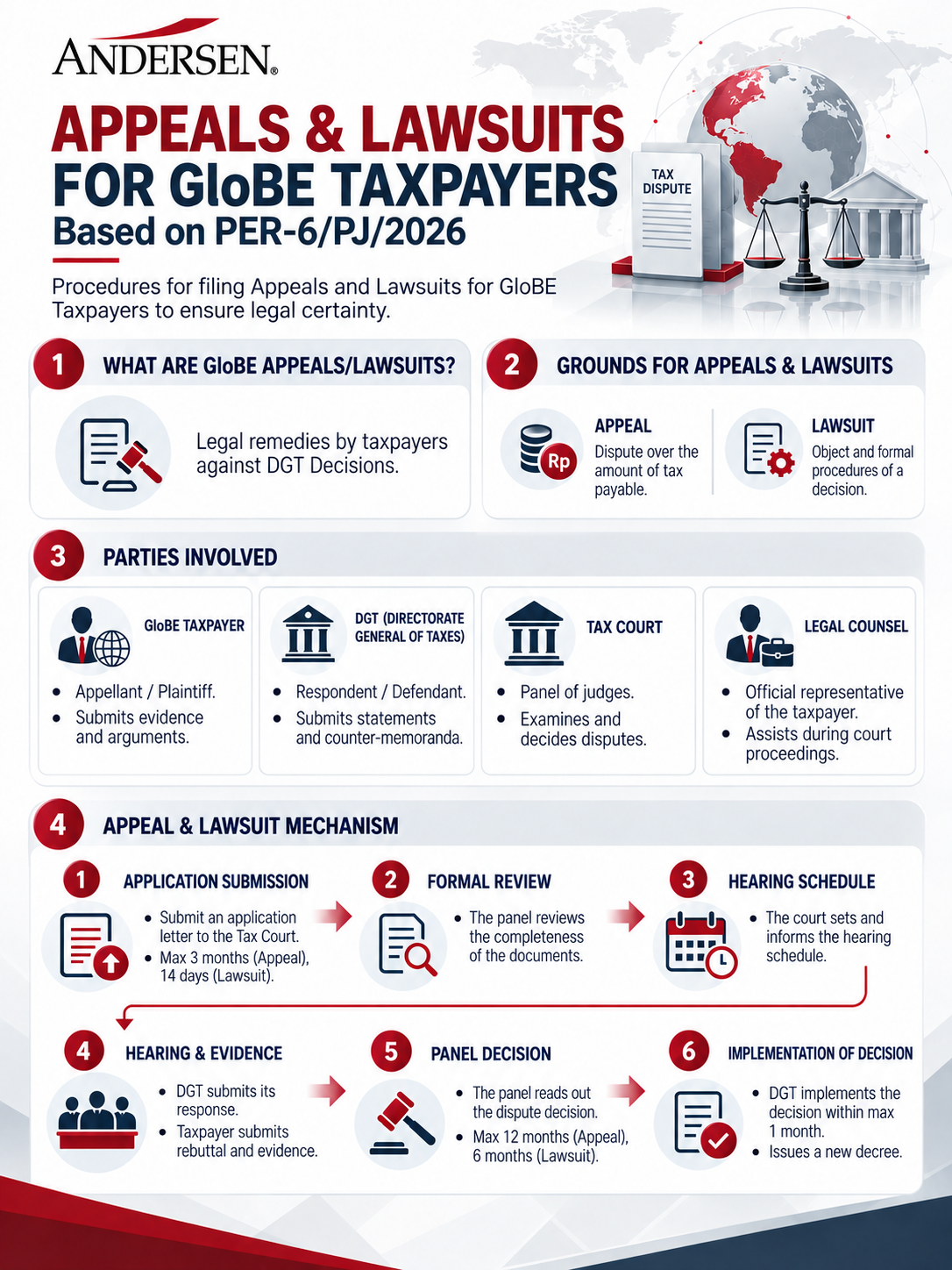
Legal Remedies for GloBE Taxpayers: Appeals and Lawsuits under PER-6/PJ/2026

Under PER-6/PJ/2026, GloBE Taxpayers in Indonesia may challenge tax decisions through two legal remedies. An appeal can be filed with the tax court only against an objection decision and generally concerns the amount of tax payable, while a lawsuit addresses procedural matters, such as tax collection actions or decisions issued without following the prescribed procedures. As GloBE obligations move beyond registration and filing, multinational groups should ensure their computations and documentation are dispute-ready.


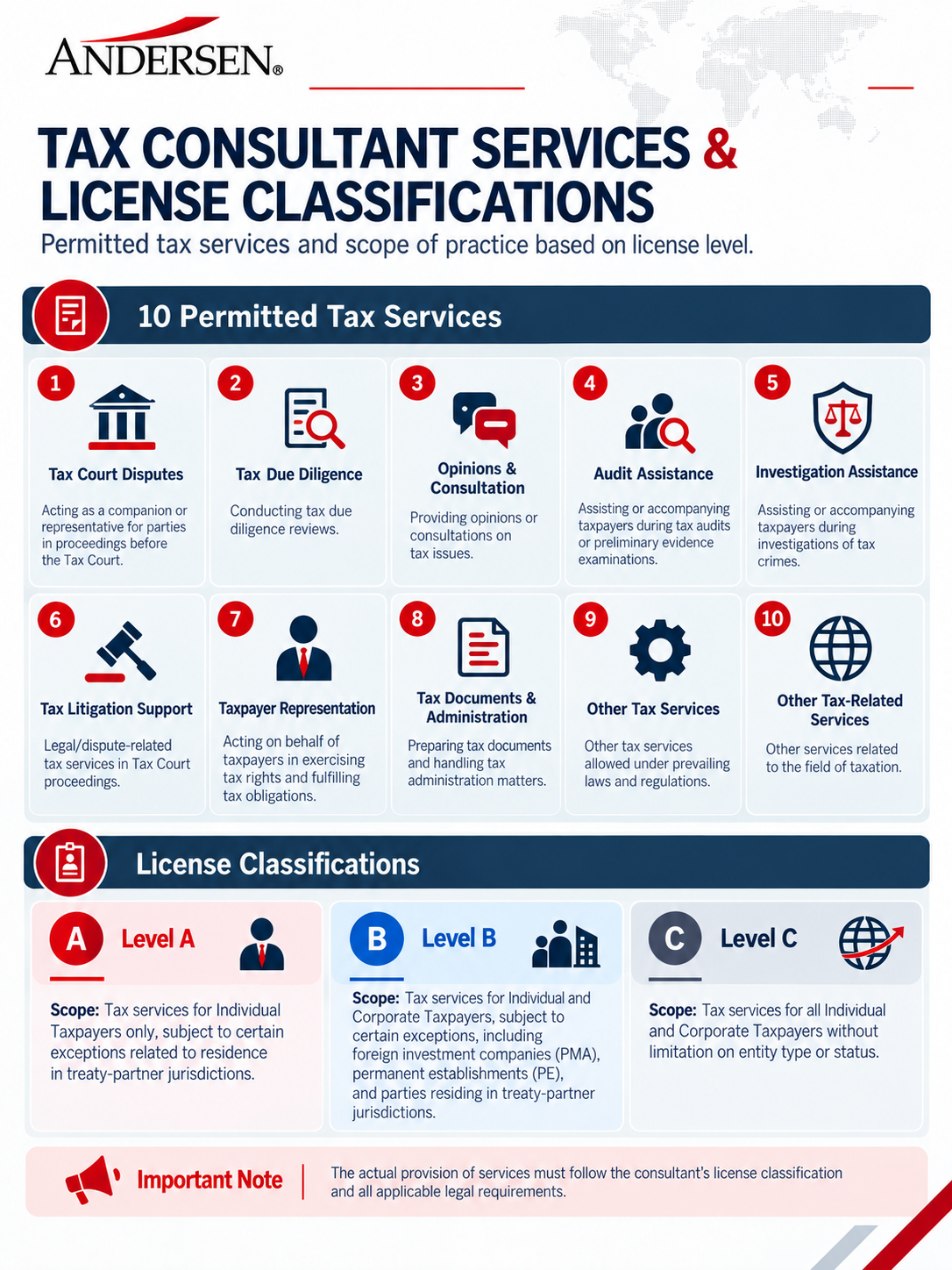
What Tax Consultants Can Do: Services and License Levels Explained

Tax Consultants in Indonesia are permitted to provide ten categories of tax services, ranging from tax court representation and litigation support to tax due diligence, audit assistance, and general tax documentation and administration. The scope of services a consultant may actually provide depends on their license classification: Level A covers individual taxpayers, Level B extends to both individual and corporate taxpayers with certain exceptions, and Level C covers all taxpayer types without limitation. The infographic below breaks down the permitted services and license levels in detail.