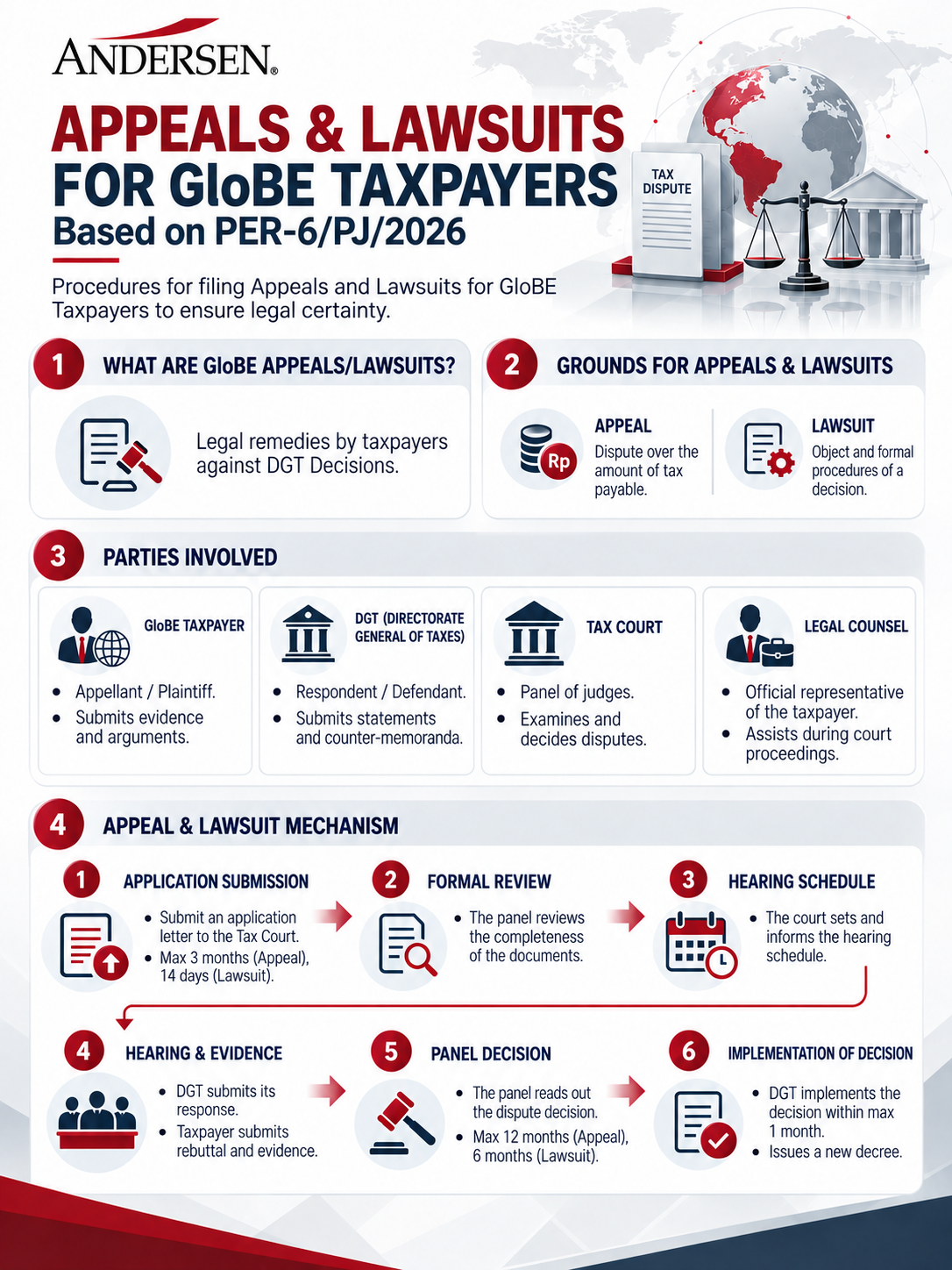
Under PER-6/PJ/2026, GloBE Taxpayers in Indonesia may challenge tax decisions through two legal remedies. An appeal can be filed with the tax court only against an objection decision and generally concerns the amount of tax payable, while a lawsuit addresses procedural matters, such as tax collection actions or decisions issued without following the prescribed procedures. As GloBE obligations move beyond registration and filing, multinational groups should ensure their computations and documentation are dispute-ready.
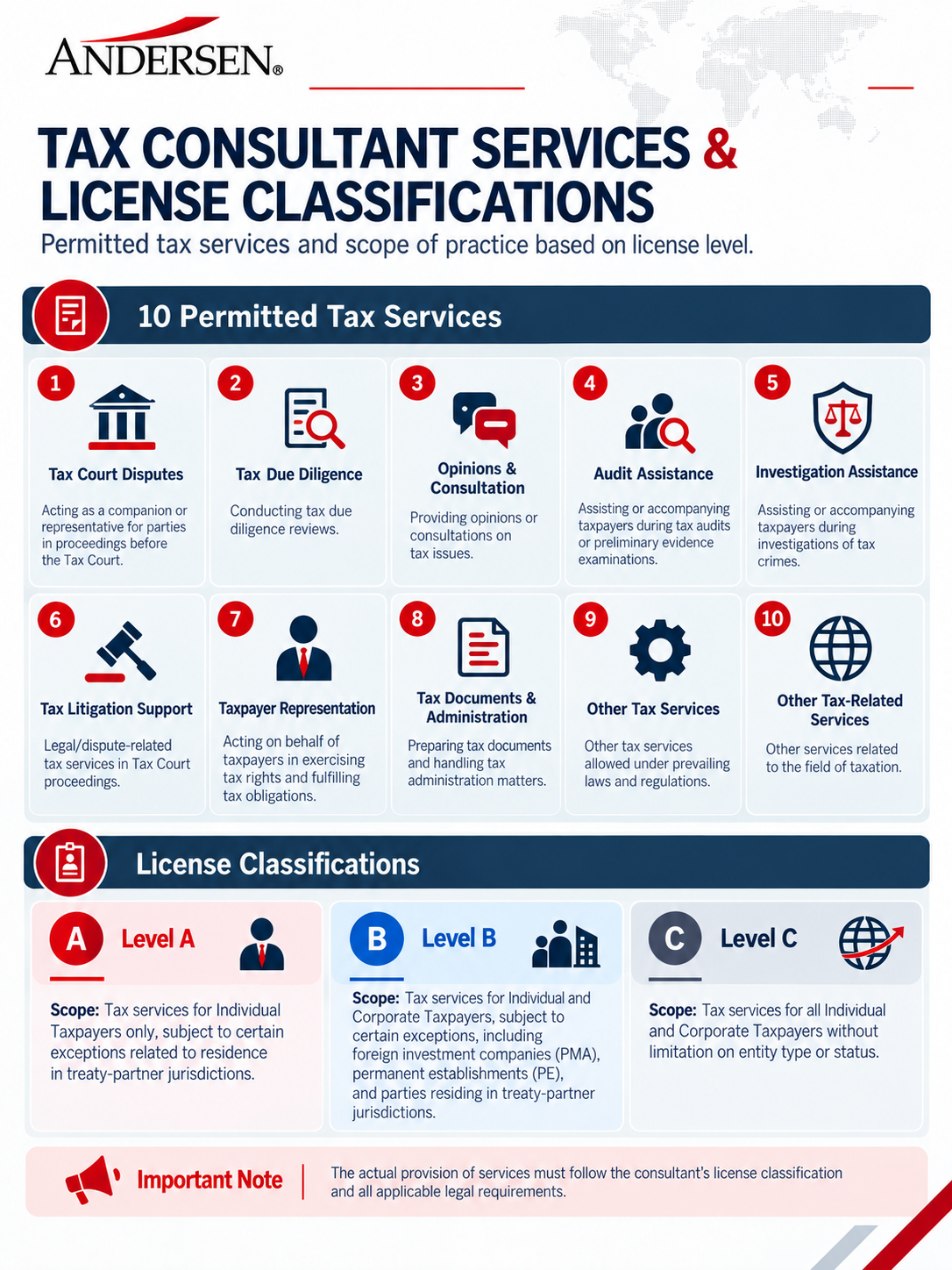
Tax Consultants in Indonesia are permitted to provide ten categories of tax services, ranging from tax court representation and litigation support to tax due diligence, audit assistance, and general tax documentation and administration. The scope of services a consultant may actually provide depends on their license classification: Level A covers individual taxpayers, Level B extends to both individual and corporate taxpayers with certain exceptions, and Level C covers all taxpayer types without limitation. The infographic below breaks down the permitted services and license levels in detail.
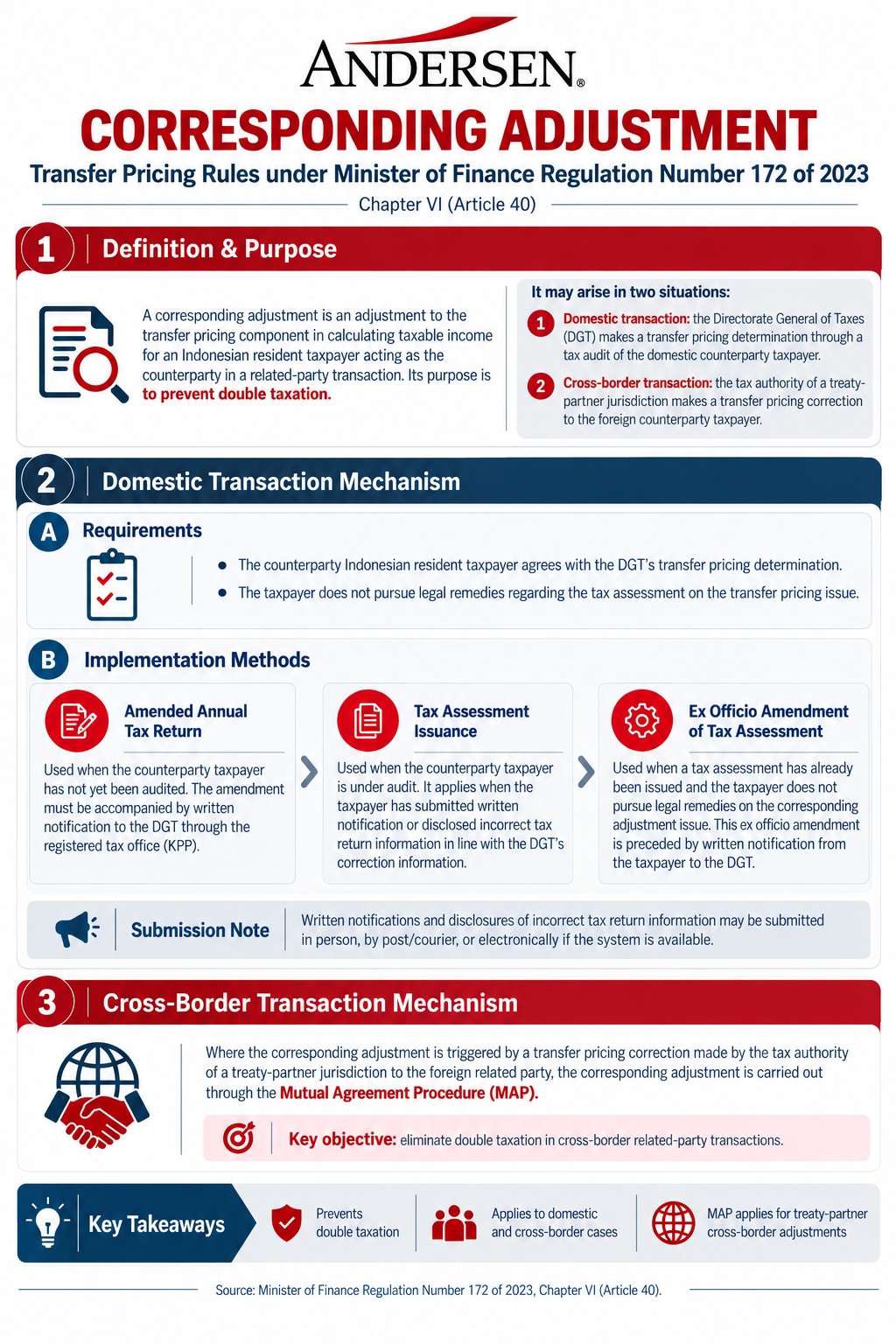
A corresponding adjustment allows an Indonesian resident taxpayer to adjust the transfer pricing component of their taxable income when a related-party transaction has already been corrected elsewhere, whether by the Directorate General of Taxes in a domestic case or by a treaty-partner tax authority in a cross-border case, in order to prevent double taxation. Under Article 40 Minister of Finance Regulation (“PMK”) No 172 of 2023, this adjustment can be carried out through an amended tax return, a tax assessment, or an ex officio amendment for domestic transactions, while cross-border cases are resolved through the Mutual Agreement Procedure (MAP). The infographic below outlines the requirements and mechanisms for both situations.
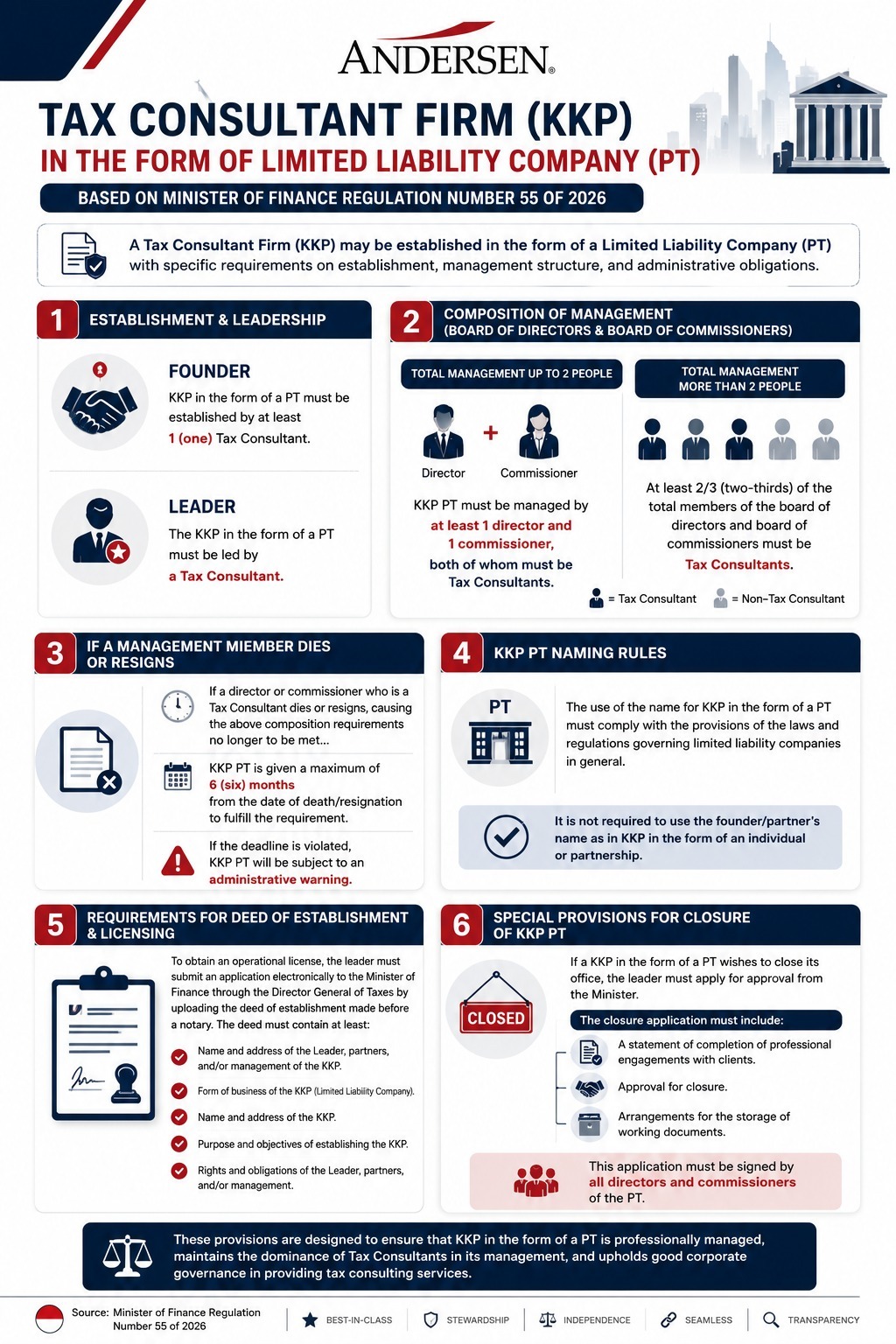
A Tax Consultant Firm (KKP) can now be established in the form of a Limited Liability Company (PT), based on Minister of Finance Regulation Number 55 of 2026. The regulation covers establishment and leadership requirements, the composition of the board of directors and commissioners, provisions for when a management member dies or resigns, naming rules for the KKP, and the process for closing the business. The infographic below summarizes the key points for Tax Consultants looking to establish or manage a KKP in the form of a PT.